
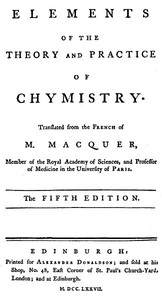
Elements of the Theory and Practice of Chymistry, 5th ed. by Pierre Joseph Macquer
Let's be clear: this is not a novel. There's no dashing hero or twisting plot. Instead, the 'story' here is the story of a science trying to find its feet. Macquer, a respected French chemist, sets out to organize everything known about 'chymistry' in the mid-1700s. The book walks you through the substances they worked with—acids, salts, metals—and the processes they used, like distillation and calcination.
The Story
The narrative is the journey of thought. It starts with the basic principles of the time, heavily influenced by the idea of four elements (earth, air, fire, water) and the mysterious 'phlogiston.' You'll see detailed recipes for experiments and explanations for why metals gain weight when they rust (a huge problem for the phlogiston theory!). As you read, you witness a disciplined mind wrestling with a world that doesn't quite make sense yet. The 'conflict' is between observation and tradition. Macquer often has to contort old theories to explain new facts. It's a fascinating, slow-motion intellectual struggle.
Why You Should Read It
I loved this book because it completely changed my perspective. We learn science as a list of facts, but here you see it raw and unfinished. It humbles you. You realize that brilliant people like Macquer were working with a fundamentally wrong toolkit, yet still making progress. It makes you appreciate the sheer grit of the scientific method. There's also a strange beauty in the archaic language—reading about 'the marriage of acids and alkalis' is more poetic than 'acid-base reaction.' It reminded me that science is a human endeavor, full of wrong turns and stubborn beliefs, just like anything else.
Final Verdict
This is a niche read, but a rewarding one. It's perfect for history or science enthusiasts who want to go beyond dates and names to feel what a paradigm shift was really like. If you've ever enjoyed a biography of a scientist like Lavoisier (who would overturn Macquer's world just decades later), this is the primary source that sets the stage. It's not for someone looking for a light narrative, but for the curious reader who thinks, 'I wonder how they actually thought about this stuff back then,' this book is a direct line to the past. Prepare to be patient, but also prepared to have your mind gently blown.
You are viewing a work that belongs to the global public domain. It is available for public use and education.
James Davis
1 month agoAfter spending a few days with this digital edition, the language used is precise without being overly academic or confusing. Highly recommended for those seeking credible information.
George Thomas
11 months agoWhile browsing through various academic sources, the objective evaluation of the pros and cons is very refreshing. An excellent example of how quality digital books should be formatted.
Donald Williams
10 months agoThe digital formatting makes it very easy to navigate.
Donald Brown
5 months agoThis was exactly the kind of deep dive I was searching for, the footnotes provide extra depth for those who want to dig deeper. A solid investment for anyone's personal development.




Jennifer Miller
4 months agoI decided to give this a try based on a colleague's recommendation, the nuanced approach to the central theme was better than I expected. Well worth the time invested in reading it.