
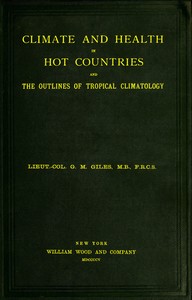
Climate and Health in Hot Countries and the Outlines of Tropical Climatology
This isn't a novel with a plot, but the story it tells is just as gripping. George Giles was a medical officer for the British Raj in India. He watched, firsthand, as soldiers and civilians fell ill with malaria, yellow fever, and other mysterious 'tropical' diseases. The common wisdom of his time was all wrong—blaming 'miasmas' (bad smells) or the personal habits of the sick. Giles started looking at the bigger picture: the heat, the humidity, the monsoon seasons, and the insects that thrived in those conditions.
The Story
Giles lays out his case like a medical detective. He methodically describes the climates of hot countries, not as a geographer, but as a doctor asking: what about this environment makes people sick? He tracks disease outbreaks against rainfall charts and temperature graphs. The real 'aha!' moment comes when he points directly at mosquitoes. He details their breeding habits in stagnant water after rains and makes a powerful, evidence-based argument for their role in spreading disease, years before this was scientifically proven and accepted. The book is his report from the front lines, arguing that to fight disease, you first have to understand the climate that creates it.
Why You Should Read It
What makes this old medical text so compelling is the clarity of Giles's thinking. You can feel his frustration with the outdated ideas of his peers. Reading his careful observations, you get a front-row seat to a major shift in scientific understanding. It’s humbling and exciting. He wasn't just sitting in a library; he was in the field, connecting mosquito bites to fever spikes. It makes our modern understanding of climate and health feel hard-won and deeply impressive. It’s also a stark reminder of the human cost of empire, told through the lens of disease and survival.
Final Verdict
This book is perfect for history and science fans who love original sources. If you're interested in the history of medicine, colonialism, or epidemiology, this is a foundational text that reads like a revelation. It's also great for anyone curious about how we came to know what we know about climate and health. Be warned, it's a detailed scientific work from 1904, so it requires a bit of focus. But if you stick with it, you're rewarded with the brilliant, commonsense insights of a doctor who was truly ahead of his time.
This historical work is free of copyright protections. It is available for public use and education.
Elizabeth Martin
6 months agoI've been looking for a reliable source on this topic, and the way the author breaks down the core concepts is remarkably clear. The insights gained here are worth every minute of reading.
Jennifer Martinez
1 year agoI wanted to compare this perspective with traditional views, the data points used to support the main thesis are quite robust. I feel much more confident in my knowledge after finishing this.
David Moore
7 months agoI found the data interpretation to be highly professional and unbiased.
Kimberly Williams
1 week agoIt’s refreshing to see such a high standard of digital publishing.







Kimberly Miller
1 year agoI decided to give this a try based on a colleague's recommendation, the narrative arc keeps the reader engaged while delivering factual content. A solid investment for anyone's personal development.