
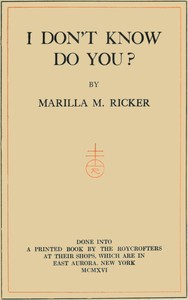
I don't know, do you? by Marilla M. Ricker
Let's get this out of the way: this isn't a novel. If you're looking for a story with a plot, characters, and a climax, you won't find it here. 'I Don't Know, Do You?' is a collection of opinions, plain and simple. Published in 1916, it's Marilla Ricker putting her thoughts on paper about the big issues of her day. She writes about her rejection of organized religion, her arguments for why women deserve full equality (including the right to vote, which was still years away nationally), and her critiques of the legal system, which she knew intimately as one of the first female lawyers in New Hampshire.
The Story
There's no narrative story. Instead, imagine sitting down for coffee with a sharp, no-nonsense great-aunt who has seen it all and has zero patience for nonsense. Each chapter is a different topic. She asks blunt questions like 'What is prayer?' and then dismantles traditional answers. She argues for rational thinking over blind faith, for personal liberty over social conformity. The 'journey' is following her logical, often sarcastic, mind as she picks apart the pillars of early 1900s society. It's less of a story and more of an intellectual assault on the status quo.
Why You Should Read It
Reading Ricker is electrifying because of her voice. She's confident, uncompromising, and funny. You feel her frustration and her intelligence on every page. It's a powerful reminder that the debates we think are modern—about gender roles, the separation of church and state, individual freedom—were raging over a century ago. It’s also a bit humbling; some of her views, particularly her embrace of eugenics, are a stark reminder that even progressive heroes are products of their flawed times. You don't have to agree with her on everything to be amazed by her courage to publish these thoughts when most women were expected to be silent.
Final Verdict
This book is perfect for history buffs who want to go beyond dates and battles to hear a real, unfiltered voice from the past. It's also great for anyone interested in the roots of feminism, secularism, or social reform. If you enjoy writers who challenge authority and make you think, you'll find a kindred spirit in Marilla Ricker. Just be ready for a direct, opinionated, and thoroughly engaging conversation across the decades.
This masterpiece is free from copyright limitations. Share knowledge freely with the world.
Paul Harris
2 years agoGiven the current trends in this field, the footnotes provide extra depth for those who want to dig deeper. I'll be recommending this to my students and colleagues alike.
Jackson Lewis
1 year agoComprehensive and well-researched.
Jessica Gonzalez
1 year agoThe fonts used are very comfortable for long reading sessions.
Betty Garcia
1 year agoAs someone who reads a lot, the plot twists are genuinely surprising. One of the best books I've read this year.





David Martin
4 months agoIt took me a while to process the complex ideas here, but the practical checklists included are a great touch for real-world use. An excellent example of how quality digital books should be formatted.